Labels & packaging · from $120 per SKU

Peptide Label and Packaging Design

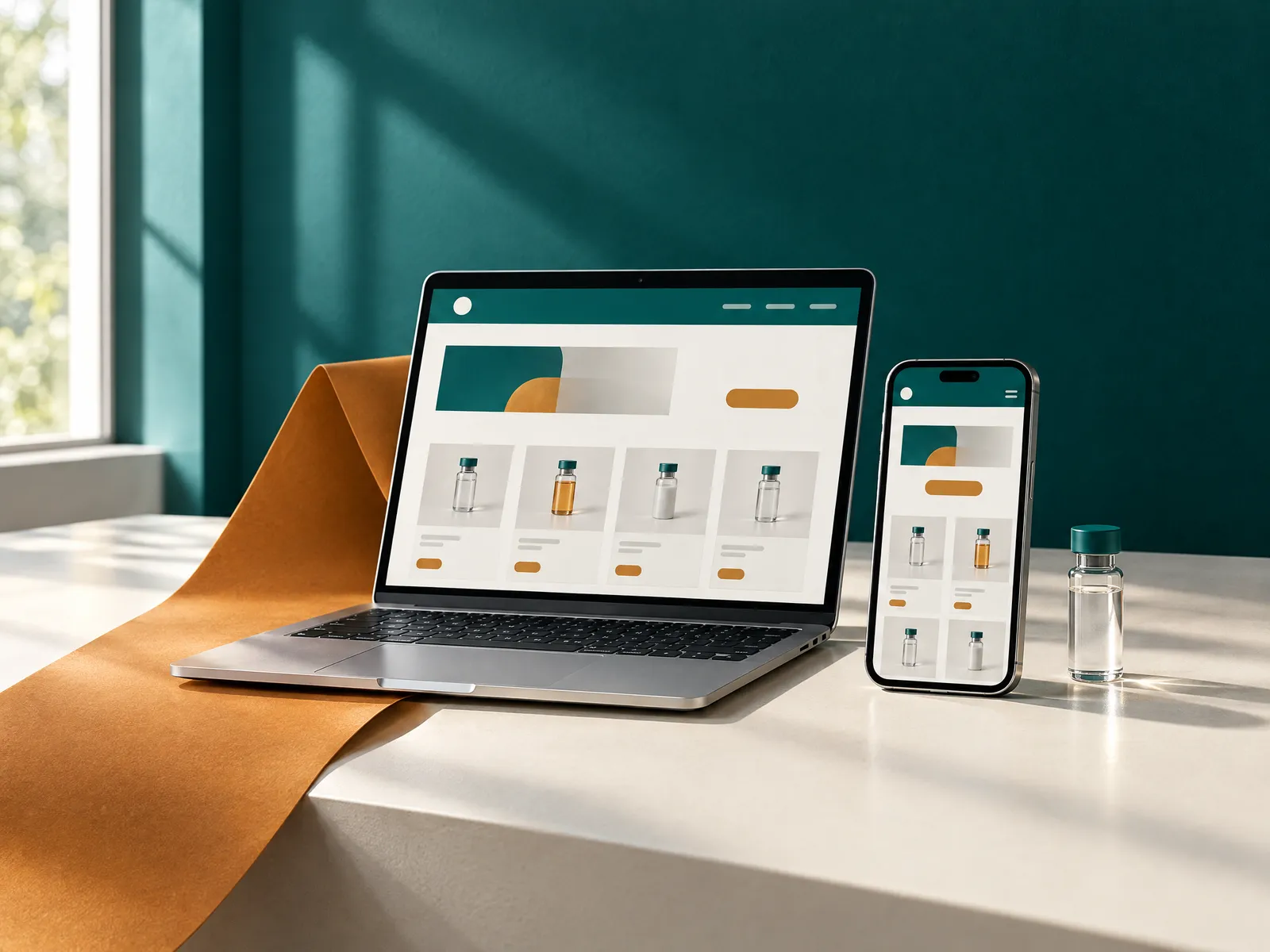
Your product photos are the first thing a buyer judges. Our peptide label design covers custom vial labels and boxes for every SKU in one consistent style, with factual research-use wording, then we render photoreal vial mockups so you can list products before the stock arrives.

  • 2, 3 and 10 mL vials
  • COA QR code on every vial
  • Photoreal mockups before stock lands

Need a quick label first? Try the free peptide label maker →

Labelled research vial on a roll of blank labels

What's included

Label systemOne grid and type scale across every SKU, sized to your measured vial.
Compliance wordingResearch-use-only statement, lot, date and storage fields, no dose or benefit copy.
COA link on every vialA QR code or short URL that opens the certificate for that exact batch.
Box and kit packagingSingle boxes and kits drawn on your printer's dieline.
Photoreal mockupsRendered from the print file, ready to list before stock lands.
Print and web filesPrint-ready PDFs with bleed, plus web images.

Who it's for

Built for these businesses

New white label brandsYou need labels, boxes and product images before the first order ships.
Stores with a patchwork catalogLabels were added one at a time and it shows. We rebuild them as one system.
Brands moving to private labelYou want packaging that looks like your brand, not a supplier's stock.
Suppliers cleaning up for reviewYour labels or photos carry dose wording or clinical imagery a processor would flag.

Your situation

Which one sounds like you?

If you're a research-use-only supplierThis is where labels matter most and protect least. We keep every vial and box factual, tie each lot to its COA, and flag where your product pages contradict the label. Labels won't get you LegitScript certified; that program isn't for RUO sellers.
If you're a clinic or telehealth businessHonestly, this service fits you less. Products a pharmacy dispenses go out under that pharmacy's labeling, not ours. We help with brand packaging and site imagery, and LegitScript application prep if you're eligible.
If you're launching a new storeDo labels and mockups before the website, not after. Renders from the print file let you build product pages and list on day one, without waiting for stock to photograph.
If you're an established storeUsually the job is consolidation: twenty labels from three designers, photos that no longer match the vial, a QR code pointing at a dead PDF. We rebuild it as one system and re-render the catalog.

Label anatomy

Seven fields on a 40 by 20 mm vial label

Every SKU starts from this layout, shown here at about six times actual size. The fields stay fixed; your brand sets the type, colour and finish.

Example layout, not a real product. Make your own in the free peptide label maker →
  1. Your brandA plain wordmark. No syringe, body or medical-cross icons.
  2. Product name and amount per vialIn mg, large enough to read in a product photo.
  3. Lot or batch numberThe one your printer fills, so each vial ties to one COA.
  4. Date fieldFill, test or expiry date, in the same place on every SKU.
  5. Storage conditionsFridge or freezer, matched to the label stock.
  6. Research-use statementOnly if it's true for how you sell, and never “Not for human consumption”.
  7. QR code to the batch COAOpens the certificate for that exact lot, checked at print size.

What goes on a peptide vial label

A peptide vial label on a 2 mL vial has roughly 40 by 20 mm to work with, and most of that is spoken for before your logo goes on. Fields first, looks second. Every label we design carries:

  • Product name and amount per vial, in mg, large enough to read in a product photo.
  • A lot or batch number your printer fills, so each vial ties to one certificate of analysis.
  • A manufacture or expiry date field and storage conditions.
  • A research-use-only statement that actually describes how you sell, not one copied because other vials have it.
  • Your brand, plus a QR code or short URL that opens the COA for that exact batch.

We leave off doses, directions, reconstitution notes, benefit wording and body imagery. FDA judges intended use from labeling, advertising and the circumstances of sale, so the label is evidence.

Why the research-use line won't protect you on its own

Here's the uncomfortable part. FDA has sent warning letters to sellers whose labels carried research-only wording and still found the products were intended as drugs. The December 2025 letter to Pinnacle Peptides is a clear example. The August 2026 letters were based on website review alone: dosing guidance, reconstitution calculators and "peptide guides" outweighed every disclaimer.

LegitScript's peptide guide for payment processors goes further. It lists a "Not for Human Consumption" disclaimer and lab-style branding with injectable vials as red flags in their own right. We can't make a vial stop looking like a vial. We can keep the label clean and factual: no syringe icons, no medical crosses, nothing that hints at how the product would be used.

So the label is one claim the rest of your business has to back up. Product pages, the COA library and your emails have to agree, because underwriters read them side by side. A dosing chart on the site undoes any label. Our compliance review for research supplier stores finds those gaps. LegitScript certifies pharmacies, telehealth and clinics, not research-use-only sellers, so an RUO store gets a review from us, not a certification. We're an agency, not a law firm: confirm the regulatory side with a lawyer familiar with FDA and FTC rules.

Sizing custom vial labels for the vial you actually buy

Most label files we're handed were drawn for a vial nobody measured. One supplier's 2 mL crimp vial is 13.75 by 35 mm, another's is 14.75 by 32 mm. A 3 mL peptide vial is often around 17 by 40 mm, and a 10 mL vial is 22.75 by 50 mm with a 20 mm neck. A 2 mL vial is about 43 to 46 mm around, so a 40 by 20 mm label wraps it with a small gap instead of burying the lot number under the seam.

We ask for the vial spec sheet (or a photo of a vial next to a ruler) and your printer's label spec before drawing anything. For fridge storage we specify BOPP film, which handles condensation without the print lifting. For anything frozen we use cryogenic thermal-transfer labels, rated from minus 196 to plus 121 °C. We'd skip paper stock entirely.

One peptide label design system for every SKU

The most common mistake in peptide label design is designing one label at a time. Twenty products later you have six fonts, three greens and a catalog that looks like three companies.

We build a system instead: a fixed grid, one type scale, a colour rule for product families or strengths, and fixed positions for the lot, date and QR fields. Your printer gets one master layout with variable fields, and SKU 21 becomes a short revision, not a fresh design round.

White label vs private label peptides: what changes for the design

White label peptides are an existing product sold to many brands, each adding its own branding. It's the cheap way to start (one supplier we looked at lists a minimum of one box of ten vials with custom labels, though that's their claim, not an industry norm). The catch: you ship the same vial as your competitors, so the label, the photos and how you present each batch's COA are most of what sets you apart.

Private label peptides are adapted to one brand's specification. Across consumer goods generally (not peptide-specific figures), private label minimums run about 1,000 to 5,000 units per SKU against 500 to 1,000 for white label. Our advice: build the system for white label stock now, with room for your own lot numbering. When you move to private label, you swap supplier details, not the design.

Peptide packaging: boxes and kits

Good peptide packaging design uses the room a box gives you: a fuller research-use statement, storage detail, the lot and date repeated, and a QR code big enough to scan at arm's length. Kits get an outer box and insert layout drawn on your printer's dieline. One line we hold: we won't design a kit that bundles bacteriostatic water or syringes with the vials. FDA's August 2026 letters cited bacteriostatic water sold alongside as evidence of human use.

Peptide vial mockups and product photography before stock lands

We render vials, boxes and kits as photoreal images with consistent lighting and angles, so a new SKU can be listed the day you approve the label. Every peptide vial mockup is rendered from the final print file, so the photo matches the vial in the buyer's hand, which heads off "not as described" disputes. Renders also beat peptide product photography on upkeep: change a strength and we re-render instead of booking a reshoot. Images slot straight into a peptide store build.

Matching your peptide label to the COA

Buyers and processors both check that the vial in hand matches its lab report. The label and the COA should show the same product name, the same amount per vial and the same lot or batch number, and the COA should carry the test date and the lab's name. When a new batch arrives, the label changes with it.

We can add a QR code to each label that opens that batch's COA, so the match takes one scan. Older batches keep their own COA entries, so last month's vial still points at the right report. You can try the same layout in the free peptide label maker.

What it costs and what to send us

A vial label plus photoreal mockup is $120 per SKU, or $96 per SKU at 10 SKUs or more. Box or kit packaging with a dieline adds $80 per SKU. Print-ready files and web images are included; the rest is on our pricing page. Send your SKU list with amounts, the vial spec, your printer's label spec, brand files and current COA links. Not sure your store would hold up next to new labels? Start with a free store audit.

Measured, not guessed

Three common vials, three different labels

Vials differ by supplier, so we draw from your spec sheet or a photo of the vial next to a ruler. Shown to scale.

2 mL vial

Vial
13.75 × 35 mm or 14.75 × 32 mm, by supplier
Around
43 to 46 mm
Label
About 40 × 20 mm, with a small gap at the seam

3 mL vial

Vial
Often around 17 × 40 mm
Label
Sized from your vial's spec sheet

10 mL vial

Vial
22.75 × 50 mm
Neck
20 mm
Label
Sized from your vial's spec sheet

What we fix

Problems we see every week

Photos that don't match the vialSupplier photos show a different label from the one that ships. We render from the final print file.
Labels sized for the wrong vialText wraps over the seam or the QR code won't scan on the curve. We design to the measured vial.
Directions on the labelAmount per vial belongs there; directions and benefit lines don't. We strip them out and keep the label factual.
No link between vial and COABuyers can't match the certificate to their batch. We add a lot field and a QR code to that batch's COA.
Every SKU looks differentOne master layout with variable fields fixes the drift and makes new SKUs quick.
Clinical styling that invites scrutinySyringe icons and medical crosses read as human-use marketing. We replace them with clean, factual design.

Before and after

A typical case: a catalog that grew one label at a time

A research supplier started with its supplier's stock labels, added new SKUs with whichever freelancer was free, and used supplier photos on the store. A processor's underwriter then asked for product images and label artwork, and side by side it looked like three different businesses. We rebuilt the labels as one system and re-rendered the catalog from the print files.

Before

  • Three label layouts and four fonts across the catalog
  • Supplier photos showing a different label
  • A strength line followed by suggested directions on two SKUs
  • No lot field, so vials couldn't be matched to a COA
  • A syringe icon in the logo lockup

After

  • One master layout with variable fields for every SKU
  • Photoreal renders made from the final print files
  • Directions removed; amount per vial and storage only
  • Lot field plus a QR code to that batch's COA
  • Syringe icon dropped for a plain wordmark
Flowing strip of cream label stock with teal-cap vials resting on it

Pricing

What it costs

Prices in US dollars. Third-party fees are paid by you directly. Packages are on the pricing page.

What you getIncludesPrice
Vial label plus photoreal mockupLabel, photoreal render, print-ready files and web images.$120 per SKU
Vial labels for 10 SKUs or moreThe same work, priced for a full catalog.$96 per SKU
Box or kit packaging with dielineA box or kit on your printer's dieline, rendered with the vial.+$80 per SKU
Research supplier store reviewWe check your store, product pages and labels the way an underwriter would, then send fixes and a findings report.from $600
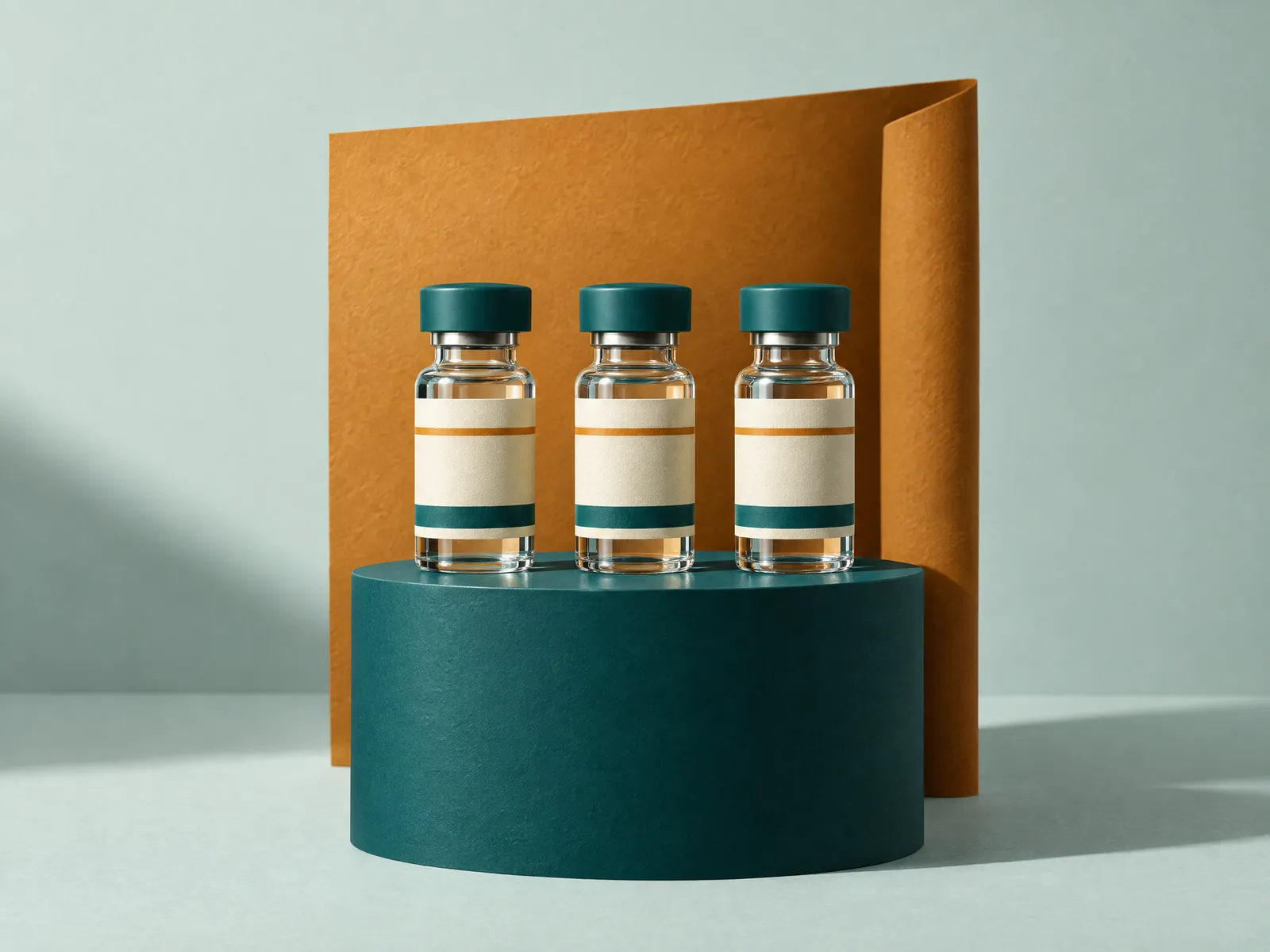
Three labelled vials on a teal plinth in front of an amber box flap

Timeline

How it runs

  1. Day 1Brief: SKU list, vial spec sheet, printer's label spec, brand files and COA links.
  2. Week 1Label system and first SKU at true size for your approval.
  3. Week 2Every remaining SKU, plus boxes and kits, with each QR code checked at print size.
  4. Week 2 to 3Photoreal mockups of every vial, box and kit, rendered from the final print files.
  5. HandoverPrint-ready PDFs plus web images for your store, marketplaces and email.

Options

Supplier label, freelance gig or a label system?

Cheaper routes exist, and for one SKU some are fine.

OptionGood forWatch out for
Supplier's stock labelA first batch with no design work.Every other brand on that supplier has the same label.
One-off freelance gigA single SKU on a tight budget.Drawn for a generic vial, with no system for the next SKU.
DIY in a template toolTesting a name before you commit.Bleed, dielines and vial sizing are easy to get wrong.
Label system from usCatalogs of five or more SKUs and brands that plan to grow.Costs more up front, and we won't add dose copy even if asked.

Our limits

What we won't do

  • We won't put doses, directions or benefit claims on a label, box or image.
  • We won't design kits that bundle bacteriostatic water or syringes with research vials.
  • We won't use syringe or body imagery in packaging or mockups.
  • We won't promise that a label gets you past a processor, an ad platform or LegitScript.
  • We won't design labels that disguise what a product is.

Who you'll work with

I run every project myself, from merchant accounts to the live site, so you talk to the person doing the work, not an account manager. If something on your store puts your processor or your rankings at risk, I'll tell you plainly and fix it. You'll get a reply within one business day.

Hammad, Founder, Peptide Marketing HQ

Related services

Often paired with labels & packaging

All services

FAQ

Labels & packaging questions

What should a peptide vial label include?

Product name, amount per vial, lot number, a date field, storage conditions, an accurate research-use-only statement, and a link to the batch COA. No doses, directions or benefit wording.

What size label fits a 2 mL peptide vial?

A 2 mL vial is about 43 to 46 mm around, so a label near 40 by 20 mm wraps it with a small gap. Vials vary by supplier, so we design to your measured vial.

Does a research use only statement make my label compliant?

No. FDA has issued warning letters to sellers whose labels carried research-only wording, judging intended use from the whole website. The statement has to be true of your whole business; confirm your position with a lawyer familiar with FDA and FTC rules.

What is the difference between white label and private label peptides?

White label is an existing product sold to many brands under their own branding. Private label is adapted to one brand's specification and usually needs larger minimum orders.

Can I list products before stock arrives?

Yes. The mockups are photoreal and rendered from the final print file, so you can list a product once the label is approved.

Do you print the labels?

No. We supply print-ready files built to your printer's spec, with bleed and dielines.

Will new labels get my store approved by a processor or LegitScript?

We can't promise any approval. LegitScript certifies pharmacies, telehealth and clinics, not research-use-only sellers; RUO stores get a compliance review from us instead.

Can the QR code link to a verifiable COA?

Yes, for that exact batch. Where the lab offers verification, link to its original report rather than a PDF you host, because a COA without a vendor name and batch ID proves very little.

Free store audit

Find out what is putting your store at risk.

Payments, website, compliance and rankings reviewed by a person, with a written fix list and a 30-minute call.