
We run healthcare PPC for peptide businesses: Meta and Google ads for certified telehealth brands, clinics and med spas, and Google Shopping and Search for research suppliers that genuinely sell business to business. Most of the work happens before anything spends. We check that you're allowed to advertise, clean the pages and product feed a reviewer will read, and set the account up so one rejected ad doesn't turn into a suspended business.
If you want a healthcare PPC agency that treats ad policy as part of the media plan, not a cleanup job after the ban, this is that service. No health claims, no tricks to get past review.
Healthcare PPC starts with what kind of business you are
Before any budget, we answer one question: what are you, as a reviewer would read it?
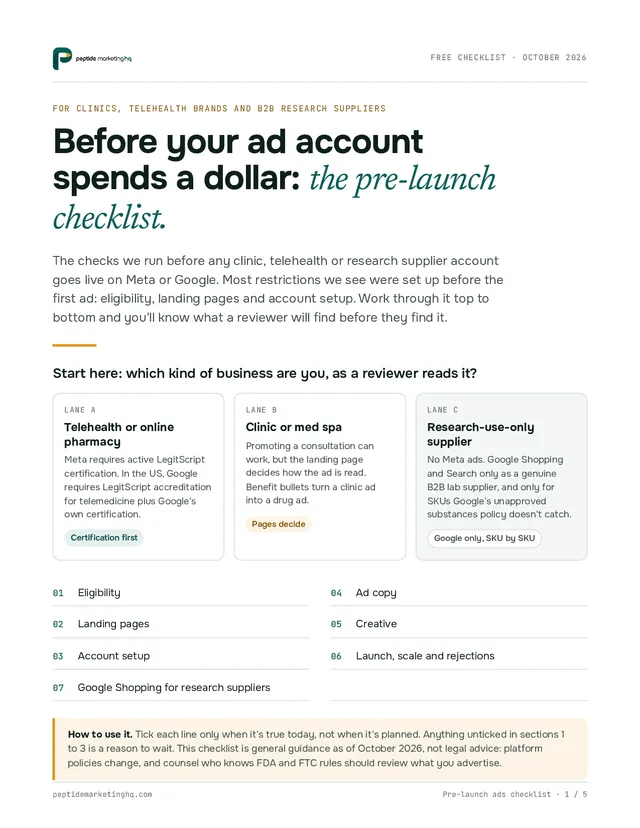
- Telehealth brands that prescribe. Meta requires online pharmacies and telehealth advertisers to be actively LegitScript certified. In the US, Google's healthcare policy allows telemedicine providers accredited by LegitScript's Healthcare Merchant Certification Program, and they also have to be certified with Google. Our LegitScript application prep covers that part.
- Clinics and med spas. Promoting a consultation is a different case from promoting a prescription drug, but the landing page decides how the ad is read. A peptide page full of benefit bullets turns a clinic ad into a drug ad.
- Research-use-only suppliers. Google only, as a real B2B scientific supplier, checked product by product. No Meta ads.
Certification follows current law: in September 2026 LegitScript said BPC-157, TB-500, retatrutide and cagrilintide aren't currently eligible, and partners count too.
Google Shopping for research peptide suppliers
Google bars promotion of certain substances "regardless of any claims of legality", including products subject to any government or regulatory action or warning, and Merchant Center extends the ban to substances with similar chemical composition. So we check every SKU against Google's list and against FDA warning letters, and anything caught stays out of the feed. For some catalogs that leaves too little to be worth advertising, and we'll tell you so before you pay for setup.
As a Google Shopping agency that only works with peptide businesses, this is the part we spend longest on. For the SKUs that remain, the store has to look and behave like a lab supplier:
- Scientific product names, sold as lyophilized powder. No bacteriostatic water or syringe bundles, no dosing, no outcome words anywhere: product copy, image text, alt text, meta tags or blog.
- A COA on every product page, with any purity figure matching the certificate.
- An accurate research-use-only statement in the header and footer. We don't add "Not for Human Consumption", because LegitScript's guide for processors lists it as a red flag.
- Business name, address, phone and email identical in the footer, Merchant Center and your verification documents, with ID and company papers ready when Google asks.
- Product schema, reviews through a Google-recognised aggregator, a shared negative keyword list, and no BOGO offers or countdown timers.
What we won't do: block Google's crawler from the cart or checkout, shrink images so labels can't be read, send clicks through a mild pre-lander to a harder sales page, or "push boundaries" once approved. Google treats that as circumventing its systems, and it can take down every linked account. Our research supplier services cover the store work.
How we run Google Search and Shopping on WooCommerce
Most of the stores we work on run WooCommerce, so our Google Shopping management starts there: the Google for WooCommerce plugin for the product feed and the conversion tag, a test order to prove purchases are tracked, and Merchant Center shipping and returns filled in to match your own policy pages. We skip the Performance Max campaign the plugin offers to create and build our own:
- A catch-all Performance Max campaign with listing groups split by item ID, so every product's spend and sales are visible.
- A separate low-budget campaign for SKUs that aren't converting, so they keep collecting data without draining the main budget.
- Search themes and custom segments built from competitor URLs and the terms your buyers actually use, with the shared negative list on top.
- Maximize conversion value at launch, then a target CPA once there's enough purchase data to steer by.
Often the ads aren't the problem. If product pages load slowly on a phone or checkout loses people, more spend buys more of that, so we fix speed and checkout first, usually as part of a care plan.
How we set up an account before it spends
- Verification first. Business and domain verification in Meta Business Manager; advertiser verification, and healthcare certification where it applies, in Google Ads.
- Your accounts, not ours. Two admins on your side with two-factor login. We're added as a partner, so you keep everything if you leave.
- One payment method in the business's name, matching your verification documents.
- Neutral tracking. Events called Lead, Booking or Purchase, with no condition or treatment in event, conversion or audience names. Meta has disabled audiences and conversions with sensitive health terms in them.
- A small first week. Conservative, brand-level ads at a low daily budget, so billing, verification and review problems show up while they're cheap.
Telehealth advertising copy that passes review
Facebook ads for healthcare get the closest read on the headline and primary text, so those stay the most conservative part of every ad:
- No drug names, compounds or mechanisms up front unless you're certified for it and there's a reason.
- No promised outcomes. We sell the process: who you'll speak to, how booking works, how quickly you hear back.
- Never tell the reader something about themselves. Meta's personal attributes policy rules out copy that implies a health condition, so "Struggling with your weight?" is out and "Talk to a licensed provider about your options" is in.
- Weight-management and health services target people 18 and over.
Creative follows the same rules: no before-and-after, no body close-ups, no branded drug packaging. We make it in the same studio as our labels and vial mockups, and stronger angles come later, one at a time.
Rejections, and what to do when your Facebook ad account is restricted
When an ad is rejected, we read the reason and decide honestly whether it crossed a line. If it's a reviewer error, we request a review once. If the ad was the problem, we remove it, fix it and submit a clean version. We never duplicate a rejected ad to force it through.
If your Facebook ad account is restricted, or your Google Merchant Center is suspended, stop launching, fix the cause across the whole funnel (ad, page, feed, domain and verification), then appeal once with a clear explanation. Don't open a new account to get around it. Your account history is the asset, and it builds slowly. Ad spend is always paid by you directly to Meta and Google; our fees are on the pricing page.
Get the free pre-launch ads checklist
We wrote down the checks we run before any account spends: eligibility, landing pages, account setup, copy, creative, launch, and a Google Shopping page for research suppliers. It's free and you don't need a call to get it. If you'd rather we run it against your account, that's the ads compliance audit below, and it's part of every setup.