
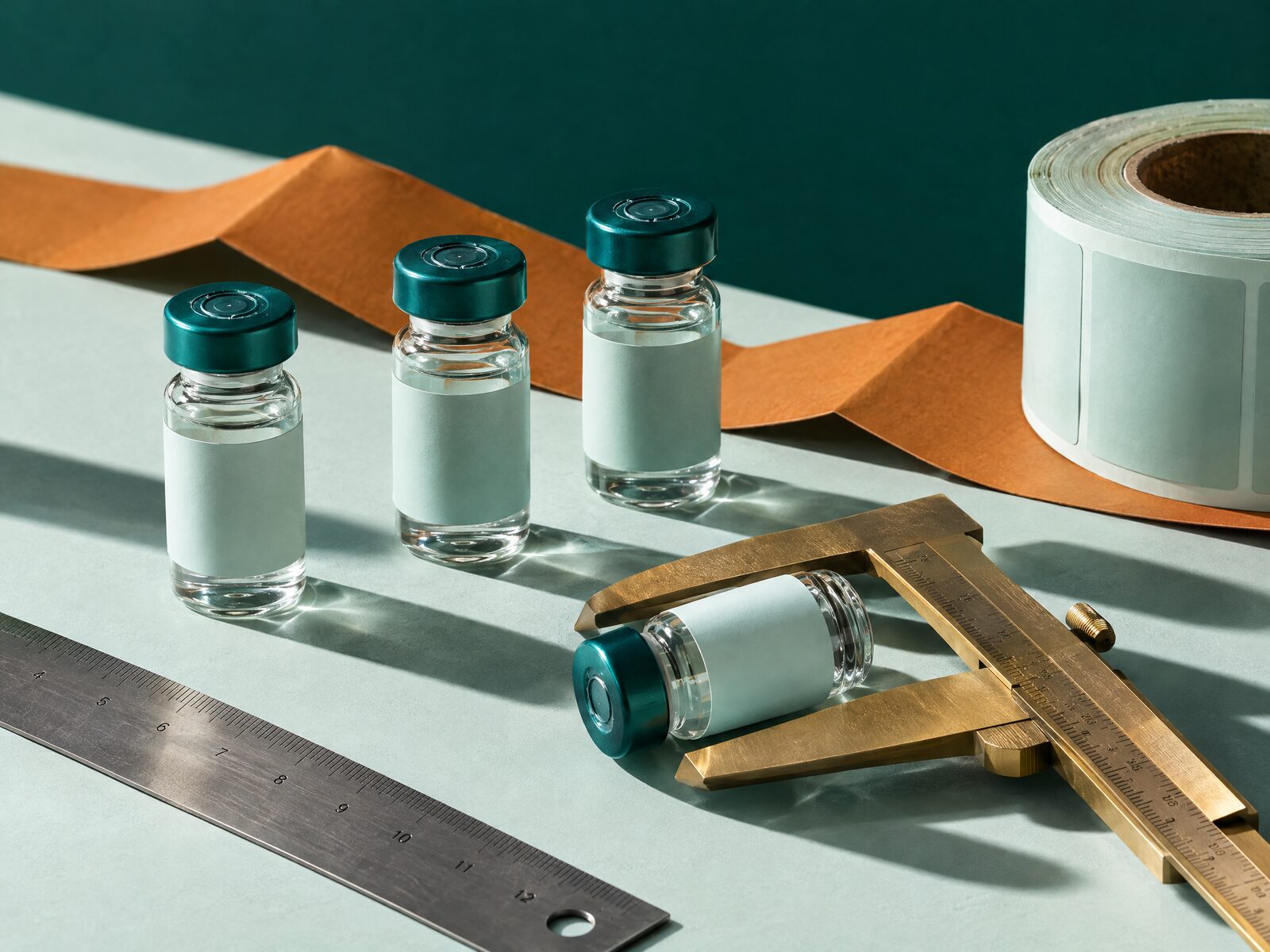
A peptide vial label has one job: tell whoever is holding the vial exactly what’s in it and which batch it came from. Everything you add beyond that is either decoration or liability, and on a label that’s 19 mm tall, decoration is already a stretch.
The other reason to keep it tight is who else reads it. FDA judges a product’s intended use from its “labeling claims, advertising matter, or oral or written statements” and the circumstances of sale, under 21 CFR 201.128. Processors and their underwriters read your labels in product photos too. So what you leave off matters as much as what you put on.
We design research peptide labels for suppliers, and the brief we push back on most is the one that wants the label to sell. Here’s what goes on, what stays off, and the sizes, stock and printing choices that decide whether it survives a freezer.
What has to be on a research peptide vial label
OnlineLabels’ peptide label guide lists the common elements, and we agree with all of them:
- Product name. The compound name, written the same way it appears on your product page and COA.
- Strength or quantity. The amount in the vial, for example “10 mg”. Nothing about how it’s used.
- Lot or batch number. The most useful thing on the label.
- Storage instructions. The conditions your supplier specifies, in as few words as possible.
- A “Research Use Only” statement. Only if it’s true. OnlineLabels makes the same point: the RUO statement has to actually describe the product, not get added because every other peptide vial has one.
No RUO-specific labeling rule for peptides dictates this list; it’s what’s common and what makes the product traceable. We’d also add your brand name or a short URL so a loose vial can be traced back to you, but that’s our recommendation, not a published standard.
What stays off a peptide vial label
Leave these off the vial, the box, the insert and the product photos:
- Dosing language of any kind. No amounts per use, no frequency, no “per injection”.
- Reconstitution instructions. No mixing volumes, no water ratios, no “add X mL”.
- Human-use language or imagery. No body silhouettes, no syringes, no “take”, “administer” or “apply”.
- Benefit words. No product names built around an outcome. If the SKU name describes what the buyer hopes will happen, rename it.
- Grade claims you can’t document. “Pharmaceutical grade” on a research-grade product is a false statement, not a branding choice.
- Badges. “99% pure” seals that aren’t tied to a specific batch COA.
Now the uncomfortable part. The RUO line on the label doesn’t protect you if everything around it points to human use. In the Pinnacle Peptides warning letter (Dec 12, 2025, covering SARMs), the labels said “FOR RESEARCH ONLY” and “NOT FOR HUMAN USE”, and FDA still found the products were intended as drugs for human use. The August 24, 2026 letters to several peptide sellers cited dosing guidance, reconstitution calculators, “peptide guides” and bacteriostatic water sold alongside, and were based on website review alone. LegitScript’s own peptides guide for payment processors lists a “Not for Human Consumption” disclaimer as a red flag, not a reassurance.
The label is one piece of a business that has to behave like a research supplier everywhere. If you’re unsure about your wording, check it with a lawyer who knows FDA and FTC rules before you print 5,000 of them.
Peptide vial label sizes for 2 mL, 3 mL and 10 mL vials
Vial dimensions vary by supplier, so never size a label from a catalog number alone. The figures we work from:
| Vial | Listed dimensions | Label figures we’ve seen sourced | Notes |
|---|---|---|---|
| 2 mL crimp | 13.75 x 35 mm (one supplier), 14.75 x 32 mm (another) | No sourced label size | Circumference is roughly 43 to 46 mm |
| 3 mL | 17 mm diameter x 40 mm (one listing) | 1.5 x 0.75 in (about 38 x 19 mm), sold for 3 mL vials | Covers about 70% of the circumference |
| 3 to 5 mL | Varies | 1.75 x 0.75 in (about 44 x 19 mm), per OnlineLabels | A common starting point |
| 10 mL crimp | 22.75 x 50 mm, 20 mm neck | No sourced label size | Circumference is roughly 71 mm |
OnlineLabels gives a general peptide-vial label range of 0.5 x 1.25 in up to 1.25 x 2.0 in, which tells you how much variation there is.
For the 2 mL vial, here’s the rule of thumb we use, and you should run it on your own vial rather than trust ours:
- Measure the outside diameter with calipers, not a ruler.
- Multiply by 3.14 to get the circumference. A 13.75 mm vial comes out around 43 mm; a 14.75 mm vial around 46 mm.
- Subtract 3 to 5 mm so the label ends leave a small gap. Overlapping ends on a tiny curve tend to lift.
- Measure the straight wall between the base curve and the shoulder, and keep the label height a millimetre or two inside it.
On a typical 2 mL vial that lands around 40 x 20 mm. You’ll see “50 x 20 mm” quoted online; we couldn’t find a source, and on a vial 43 to 46 mm around it would wrap past itself.
Before a full run, stick a few blank labels in the exact size on vials from your actual supplier. Two suppliers’ “2 mL” vials can differ by a full millimetre in diameter, which changes the wrap by about 3 mm.
Label materials that survive the freezer and condensation
Paper labels are the most common failure we see: condensation forms when a vial leaves cold storage, and within a week the paper has wrinkled and the lot number has smudged.
- BOPP film. OnlineLabels describes BOPP as durable and moisture-resistant, and suited to refrigerated, condensation-prone vials. It’s our default. White BOPP for most designs, clear BOPP if you want the vial to show through (budget for a white ink underlay behind text, or it disappears against the contents).
- A laminate or varnish. A matte laminate protects print on a label that gets handled constantly, and cuts glare in photos.
- The adhesive matters as much as the face stock. Ask the printer for the minimum application temperature and the service temperature range. A label that’s fine in a fridge can let go in a freezer.
- Cryogenic labels for frozen storage. Lab suppliers sell cryogenic thermal-transfer labels; one listing rates them from minus 196 °C to plus 121 °C and says they can be applied to surfaces already frozen to minus 80 °C. They’re usually plain white stock you print onto, which suits lot-number overprinting.
Our test before approving any stock: label ten vials, store them as the product will be stored for a week, let them sweat at room temperature, then rub the lot number hard with a thumb. If anything lifts or smears, it’s the wrong stock.
Lot numbers and a QR code that goes to the batch COA
The lot number connects a vial to its certificate of analysis. If it’s unreadable or doesn’t match the COA, the testing story falls apart.
- Keep lot codes short and unambiguous. Avoid letters that read as numbers (O and 0, I and 1).
- Print it in a clear sans or monospace face, bold, never in the lightest weight on the label.
- The lot on the vial, the box, the COA PDF and the web page must be identical. If your supplier’s lot differs from your internal one, show both on the COA page.
A QR code that lands on the exact batch COA is the best use of space on the label, but only if the link is yours. Point it at a short URL on your own domain (yourbrand.com/coa/LOT), not a free QR generator’s redirect that can expire. We build these batch pages as part of peptide website design, because the QR is only as good as the page it opens.
We don’t go below about 10 mm square, keep the quiet zone (the blank margin around the code) intact, and test the printed proof on a curved vial with three phones. If a 2 mL vial is too small for a reliable scan, put the QR on the box.
Laying out the vial label and the outer box
On a curved vial you can only see about a third of the label at once, so we design it as three panels:
- Front: product name and amount, large.
- Side: lot number and storage line.
- Back: RUO statement, brand or URL, and the QR if it fits.
Type rules we hold to: nothing under 6 pt, no hairline weights, and no tiny text reversed out of a colored band unless the printer has proven they can hold it. We’d skip faux-pharma styling (fake Rx marks, prescription-style layouts); it reads as a claim.
The vial carries the minimum. The box carries everything else, because it has the room. Here’s the checklist we use for both:
| Must have | Nice to have | Leave off |
|---|---|---|
| Product name | Brand name or short URL on the vial | Dosing or frequency |
| Strength or quantity in the vial | QR code to the batch COA | Reconstitution or mixing instructions |
| Lot or batch number (vial and box) | Test or manufacture date from the supplier | Human-use words, body or syringe imagery |
| Storage instructions | Color code by product family | Benefit or outcome language in names |
| Accurate RUO statement | Box: company name and contact URL | “Pharmaceutical grade” or undocumented purity badges |
| Box: vial count and SKU | Box: barcode for fulfilment | Anything you’d be uncomfortable reading aloud to an FDA reviewer |
Nothing about use goes on the box either: no insert with instructions, no QR to a “guide”.
Printing options: digital short runs vs roll labels
- Digital printing. No plates, so short runs and many SKUs are affordable, and it handles variable data like lot numbers. Right while artwork is still changing; pricier per label at volume.
- Flexo roll labels. Plates and setup cost up front, cheaper per label at high quantities. Worth it once a SKU’s artwork has stayed the same for a few reorders.
- Pre-printed stock plus in-house overprint. Print the design in volume with a blank lot box, then add lot numbers with a thermal-transfer printer as each batch arrives. This is what we’d recommend for most growing brands.
- Rolls vs sheets. Sheets work for a few hundred vials labelled by hand. Applicators need rolls, with the core size and unwind direction from the machine’s manual.
Always ask for a physical proof on the real stock; teal on white BOPP never looks like teal on screen.
What we’d do before you order labels
Measure vials from your actual supplier and print a test sheet at size. Strip the copy back to the must-have column. Set up the COA URL structure before the QR code goes to print, then run the freezer test on the stock you’ve picked.
If you’d rather hand over the vial specs and get print-ready files back with sizing, stock and compliance checked, that’s what our peptide label and packaging design service does.
FAQ
What size label fits a 2 mL peptide vial?
Measure your own vial. A 2 mL crimp vial is roughly 13.75 to 14.75 mm in diameter, about 43 to 46 mm around, so a label near 40 x 20 mm usually wraps with a small gap. Test blanks on your supplier’s vials first.
Do research peptide labels need a “research use only” statement?
It’s a common element, but only use it if it accurately describes the product. It isn’t a shield: FDA has found products intended for human use despite RUO and “not for human use” labels.
What label material works for frozen or refrigerated vials?
BOPP film with a cold-rated adhesive is our default for refrigerated vials prone to condensation. For frozen storage, cryogenic thermal-transfer labels are rated for much lower temperatures. Avoid paper, which wrinkles and smudges once condensation forms.
Should the QR code go on the vial or the box?
On the vial if it scans reliably at about 10 mm square or larger, otherwise on the box. Either way it should point to a URL on your own domain that opens the COA for that exact lot.
